

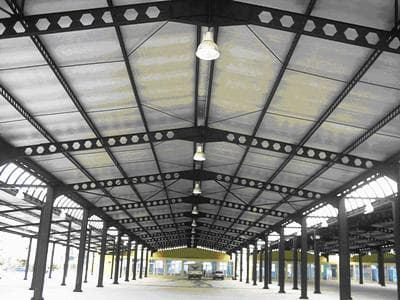
We examine the critical factors when choosing the right sandwich panel for your project — insulation thickness, core material (PUR, PIR, EPS, rockwool), fire resistance and coating type.
Sandwich panels are composite building materials widely used as roof and façade cladding in the construction sector, made of insulation filling compressed between two metal faces. Choosing the right product is critical for your building's energy efficiency, fire safety and long service life. In this guide we review the key criteria to consider when selecting a sandwich panel.
1. Core Material: Which Insulation Should I Choose?
The most important factor determining the performance of sandwich panels is the insulation core between the two steel sheets. There are four common core types on the Turkish market:
| Core Type | Thermal Conductivity (W/mK) | Fire Class | Typical Use |
|---|---|---|---|
| PUR (Polyurethane) | 0.022 – 0.024 | B-s2,d0 | General-purpose roof/façade |
| PIR (Polyisocyanurate) | 0.022 – 0.024 | B-s1,d0 | Areas with high fire sensitivity |
| EPS (Expanded Polystyrene) | 0.034 – 0.038 | E | Budget-focused projects |
| Rockwool (Mineral Wool) | 0.038 – 0.042 | A1 / A2-s1,d0 | Industrial facilities, warehouses |
PUR and PIR provide the best thermal insulation, but their fire resistance is lower than rockwool. Rockwool, on the other hand, is the leader of its class in fire safety and belongs to the A1 (non-combustible) material group — it is preferred especially for industrial warehouses, factories and sensitive structures.
2. Panel Thickness and Thermal Transmittance
Panel thickness is directly related to the U-value (thermal transmittance coefficient). Thickness should be determined according to your climate zone and your building's energy performance target:
- 40 mm: Visual cladding only, in temperate climates without cold storage
- 60 mm: General-purpose industrial structures (TS 825 minimum)
- 80–100 mm: Cold storage rooms, production facilities
- 120–200 mm: Freezer rooms, advanced energy performance
3. Roof vs Façade: Which Profile Do I Need?
The surface profile of sandwich panels varies according to the application. Roof panels are usually 3-rib or 5-rib and have a trapezoidal cross-section to channel water flow. Façade panels have a flat or slightly embossed (micro-profile) surface where aesthetics take priority.
Unlike traditional roof panels, membrane-covered terrace roof panels carry a waterproofing membrane on the upper surface and are used in non-sloped terrace applications.
4. Surface Coating: Polyester or PVC Plastisol?
The paint coating on the panel surface determines corrosion resistance and visual quality:
- Polyester (25 µm): Standard indoor and outdoor, economical
- Polyester (35 µm): Longer life, aggressive climates
- PVC Plastisol (200 µm): Coastal regions, chemical facilities — maximum corrosion resistance
- PVDF (Kynar 500): Monumental structures, 25+ year color warranty
5. Certificates and Standards
It is essential that your sandwich panel supplier document TS EN 14509 compliance. Also request documentation confirming the fire class of the core material (EN 13501-1) and that the metal faces are produced in accordance with TS EN 10169 (painted steel) and TS EN 10346 (galvanized steel) standards.
In Summary
Choosing a sandwich panel requires taking into account not only price but also the energy savings, fire safety and maintenance costs it will bring over the life of your project. For the right product, always consider the four pillars of thickness, core type, coating and certification.
As Murat Tiritoğlu A.Ş., we supply all variants of PUR, PIR, EPS and rockwool-filled sandwich panels from stock, and offer project-specific technical consultancy and application support. Get in touch and let's plan the right solution for your needs together.